Creating reports, alerts, rules, and dashboards are powerful ways to analyze large volumes of data in Splunk and stay informed when something unusual occurs. At its core, Splunk is a data platform that ingests, indexes, and enables visibility into log data. But visibility alone isn’t enough for a modern SOC. To move from observing threats to actively managing and mitigating them, Splunk offers Enterprise Security for detection and investigation, as well as SOAR for automated response.
Note: The advanced Splunk security solutions discussed in this section, such as Enterprise Security, UEBA, and SOAR, are not installed in this lab environment. The examples shown are included to illustrate how organizations extend Splunk in real-world SOC environments.
Splunk Enterprise Security
Enterprise Security (ES) is Splunk’s premium, paid security analytics add-on, designed to sit on top of your Splunk Enterprise or Cloud environment. It provides a full security operations framework that goes far beyond basic log searching or dashboard building.
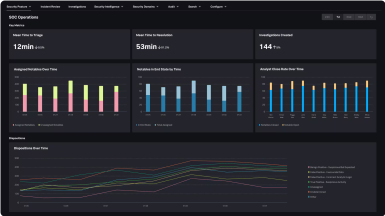
ES provides full SOC visibility, giving analysts insight into operational metrics. The SOC Operations view below helps teams understand their overall efficiency, workload distribution, and where bottlenecks may be forming, ensuring incidents are not only detected but handled quickly and consistently.
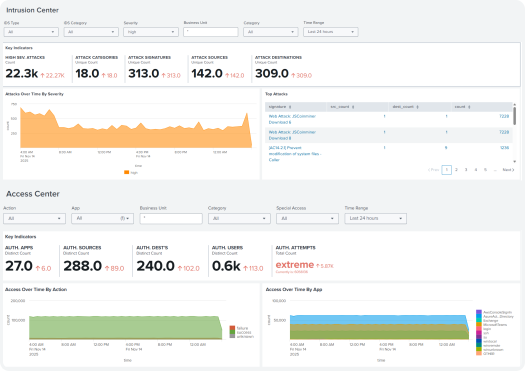
Instead of simply searching data or building dashboards, ES applies context, correlations, and threat models across your organization’s infrastructure. It can transform events into meaningful insights by mapping detections to the MITRE ATT&CK framework, aggregating events to provide risk scores, and pointing out events that represent real threats. ES also includes capabilities such as notable events, threat intelligence integration, correlation searches, and investigation workflows that help SOCs enhance their detection and response processes.
Splunk UEBA
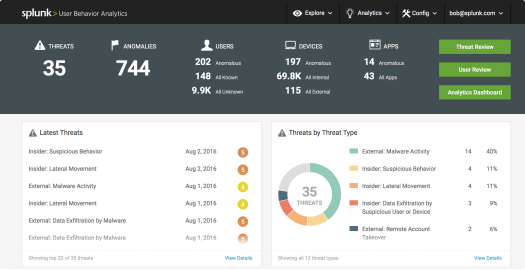
Splunk’s User and Entity Behavior Analytics (UEBA) is a tool within ES, built to detect insider threats, compromised accounts, and suspicious activity that may be missed by other detection measures. UEBA analyzes user and entity behavior, including hosts, servers, and applications, allowing for the detection of anomalies across your organization’s environment.
UEBA assigns risk scores to users and entities by evaluating behavior and events over time. It has the ability to aggregate multiple events, such as unusual logins, abnormal access patterns, and suspicious process activity, to build a risk score that gives the likelihood of malicious behavior. This information is mapped to MITRE ATT&CK techniques, which enable analysts to determine which phase of an attack it may align with.
Splunk SOAR
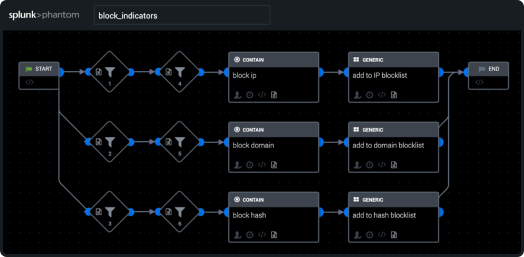
Splunk’s SOAR, formerly known as Splunk Phantom, is a paid product; however, a free Community Edition is available for on-premises deployments. It brings automation to the SOC by enabling detections to be turned into automated responses. While analysts manually investigate alerts, check IP reputation, isolate hosts, or disable accounts, SOAR can perform these actions automatically through the use of playbooks that integrate with industry security tools. This reduces response time, eliminates repetitive work, and ensures consistency when handling incidents. By combining ES’s analytics with SOAR’s automated actions, SOCs can transition from simply identifying threats to effectively eliminating them.
In the screenshot below, you can see how SOAR allows for the fine-tuning of workflows using conditions, filters, and decision nodes. This enables highly adaptive playbooks that react differently depending on the type of artifact detected, severity, or enrichment results.